



East Africa: Egypt, Ethiopia Lock Horns Over Mega Dam BY BINYAM ALEMAYEHU
Egypt has repeatedly shown its disdain towards the construction of the dam, often citing colonial agreements A disagreement between Ethiopia and Egypt over the construction of the Great Ethiopian Renaissance Dam (GERD) has once again stalled negotiations. This came following some demands forwarded by Egypt, which Ethiopia finds unacceptable. Egypt has officially demanded that Ethiopia […]
Read More →L’Oreal halts sale of Garnier brand in China
 French cosmetics group L’Oreal said Wednesday it was halting the sale of its Garnier brand in China, the latest Western company to get cold feet over a chill in luxury sales. In order to reinforce its leading position on the Chinese cosmetics market “…the decision was taken to halt the commercialisation of the Garnier brand in China,” the company said in an email to AFP. L’Oreal said it would now focus on its L’Oreal Paris and Maybelline New York mass market brands in China, which have been enjoyed better sales there than Garnier.
Tech tie-up says to launch smartphone OS to rival iOS, Android
 A new smartphone operating system developed by a global collaboration of tech firms to rival Google’s Android and Apple’s iOS is expected to launch in the next few months, Japanese mobile phone operator NTT Docomo said Wednesday. The open source offering called Tizen, based on the Linux operating system, could be installed on telephones sold from the end of March, NTT Docomo spokesman Jun Otori told AFP. Tizen is the product of a tie-up among companies from Japan, China, South Korea, Europe and the United States and comes despite tensions among the Asian neighbours over territorial disputes.
China aims to ban smoking in public places by end of the year
 China aims to impose a nationwide ban on smoking in public places this year, as authorities move to stamp out a widespread practice that has taken a severe toll on citizens’ health. China, home to some 300 million smokers, is the world’s largest consumer of tobacco, and smoking is a ubiquitous part of social life, particularly for men. Tougher regulation of smoking is a priority this year, officials from the National Health and Family Planning Commission said this week, adding that the agency was pushing lawmakers to toughen laws on tobacco use. “Compared to the damage to health that smoking causes, tobacco’s economic benefits are trivial,” Mao Qun’an, a spokesman for the commission, told a news conference on Tuesday.
China online marketplace Taobao to ban Bitcoins
 China’s largest online marketplace, Alibaba Group’s Taobao, said Wednesday that it would ban the trading of Bitcoin and other virtual currencies from January 14, after a government crackdown on the units. The People’s Bank of China (PBoC), the country’s central bank, in December ordered financial institutions to halt Bitcoin-related services and products and cautioned against its potential use in money-laundering, according to a statement. The PBoC also banned domestic third-party payment companies from providing clearing services for virtual currencies, according to state media reports. “Newly added rules include a ban on sales of Internet virtual currencies like Bitcoin and Litecoin,” it said.
High-stakes games: Tencent rolls the dice on mobile
 By Paul Carsten and Pete Sweeney BEIJING/SHANGHAI (Reuters) – Tencent Holdings, China’s largest Internet company by revenue, is betting that one-upmanship between friends playing addictive mobile games will boost revenue from WeChat, a social messaging app used by over half of all Chinese smartphone users. The company, led by billionaire CEO and Chairman Pony Ma, last week released an update to WeChat, or Weixin, hoping the addition of games, paid-for emoticons, or stickers, and a mobile payment system will help it cash in on a client base of more than 300 million people. Tencent doesn’t charge users to download and play WeChat’s ‘freemium’ games such as Tiantian Ai Xiaochu, which is similar to “Candy Crush Saga”, the world’s top grossing app, according to Think Gaming. Instead, WeChat’s social networking features encourage friendly competition between players and their contacts by sharing scores.
Alibaba division bans bitcoin after China crackdown as IPO looms
 China’s biggest online marketplace, Alibaba Group Holding Ltd’s Taobao, will ban the sale of bitcoins on the heels of a government crackdown against the virtual currency to plug a potential gap in its tight controls on capital flows. The move comes as Alibaba, China’s biggest e-commerce company, seeks the smoothest of rides toward a giant initial public offering of stock expected later this year. Taobao’s move to fall in line with the government’s wishes also comes as Alibaba presses on with efforts to stamp out the sale of fake goods on the online marketplace ahead of the IPO. Alibaba has been conservatively estimated to be worth over $100 billion.
Chinese Good Samaritan kills himself over accusations
 A man who aided a senior citizen only to be accused of knocking him down has committed suicide in the face of demands for compensation, Chinese media reported Wednesday. The story is an extreme case of a Good Samaritan tale gone sour in China, where recent reports of helpers facing huge financial demands have triggered a heated debate over the country’s law and morals. Wu Weiqing, 46, from Dongyuan in the southern province of Guangdong, was riding his motorbike on New Year’s Eve when he came across an elderly man who appeared to have been knocked over, Wu’s widow told the Southern Metropolis Daily newspaper. His daughter Wu Haiyan told the Guangzhou Daily newspaper that two days later her father said to friends and relatives that the old man’s family was demanding a huge sum for “medical fees”.
Most China execs say cannot work with Japan firms: poll
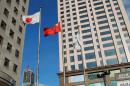 About 60 percent of Chinese corporate leaders say they cannot do business with Japanese firms because of thorny relations between the two countries, a poll published Wednesday showed. However the survey, carried out jointly by the Nikkei of Japan, South Korea’s Maeil Business Newspaper and China’s Global Times, found around 80 percent of Japanese executives have no problem dealing with companies from the other two countries. That stands in marked contrast to just 13 percent of Chinese businessmen who said they were able to separate their company’s dealings from the diplomatic frostiness. That was exemplified by the visit last month to Tokyo’s Yasukuni Shrine by Japanese Prime Minister Shinzo Abe, which he claimed was a bid to promote peace.
Taiwan gets US submarine-launched missiles
 Taiwan has received the first shipment of anti-ship missiles which it ordered from the United States for its submarines, strengthening their attack capability, a senior official was Wednesday quoted as saying. Taiwan ordered the Harpoon missiles in 2008 as part of a $6.5 billion arms purchase which sparked strong protests from Beijing. The first batch of such missiles for the navy’s two Dutch-built submarines has been shipped to Taiwan, the state Central News Agency said, citing a recent report to a closed session of parliament by deputy defence minister Andrew Hsia. The report said Taiwan spent Tw$5.9 billion ($194 million) on the missiles, but did not say how many had been bought and the number delivered.
